Chinese Bank Sanctions Loom Over Xi's US Visit
Potential sanctions on Chinese banks amid Xi's US visit shake investor confidence in China's financial sector and US-China trade ties.
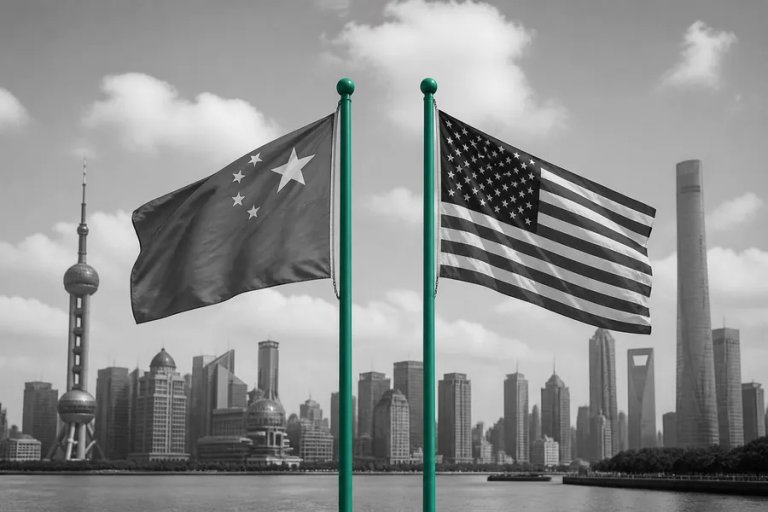
President Trump signaled possible sanctions against Chinese banks on Thursday, even as U.S. and Chinese officials pressed ahead with preparations for Xi Jinping's state visit to Washington next month.
The dual-track dynamic - sharp rhetoric paired with active diplomacy - introduces fresh uncertainty for investors exposed to U.S.-listed Chinese financials and multinationals with significant China revenue, at a moment when the bilateral trade truce remains fragile.
Key Takeaways
- Trump threatened Chinese bank sanctions tied to Iran oil trade.
- Xi's Washington state visit preparations continue despite tension.
- Analysts view Bessent's comments as largely a warning signal.
Market Context & Investor Stakes
The threat of secondary sanctions targeting Chinese banks - institutions that collectively hold trillions in dollar-denominated assets and serve as critical conduits for U.S. exporters operating in China - would rank among the most disruptive financial escalations since the peak of the 2018-2019 trade war. Stocks in sectors with heavy China exposure, from semiconductors to luxury consumer goods, have historically retreated sharply on credible sanctions signals. 1
Trump said Thursday he "could be sanctioning Chinese banks" and added, "I don't have to announce everything," according to a Fox News stream of the event. The comments followed a Wednesday meeting in Beijing between U.S. Ambassador to China David Perdue and Chinese Foreign Minister Wang Yi, called specifically to coordinate logistics for Xi's upcoming state visit. 1
Detailed Analysis: Rhetoric vs. Reality
Treasury Secretary Scott Bessent set the stage earlier this week as part of what the administration dubbed its "economic D-Day" against Iran, warning that Chinese banks "part of the ecosystem that turns Iranian oil into money, into repression, will be targeted." 1 However, analysts noted the absence of specific enforcement mechanisms or named institutions.
Jodie Wen, postdoctoral fellow at the Center for International Security and Strategy at Tsinghua University, said the Bessent comments constitute more of a warning than a concrete action, noting that few operational details accompanied the announcement. Beijing's official response has been correspondingly muted, with the foreign ministry saying only that China would "take all necessary measures" to protect its interests, without specifying what those measures would entail. 1
China has also developed a legal architecture that gives it insulation. Han Shen Lin, China managing director for The Asia Group and a former executive at Wells Fargo Bank in China, said Beijing's framework effectively tells Chinese companies that their foreign bankers must comply with U.S. rules, while inside China, domestic law takes precedence - a structure that allows partial compliance without full capitulation. 1
This tension between escalation and engagement is also visible in the broader trade landscape; Ford Motor's recent decision to shift Lincoln production to reduce China tariff exposure illustrates how U.S. corporations are already repositioning around regulatory risk even before formal sanctions materialize.
Outlook & Expert Quote
Ryan Hass, director of the China center and Chair in Taiwan studies at the Brookings Institution - who previously served as director for China, Taiwan and Mongolia on the Obama administration's National Security Council - offered a pointed read on Beijing's likely interpretation.
"Sec. Bessent already basically gave away the game when he responded to a question by asking, 'Why would I want to blow up the global financial system?' Beijing will interpret this as signaling that the U.S. is not going to go after major Chinese financial institutions." 1
Hass added that he expects the U.S.-China trade truce to remain intact because the "alternative is worse for both sides." Separately, Tsinghua's Wen noted that the Trump-Xi summit held in May marked a shift toward what analysts have called "controlled competition," departing from the prior administration's framing of China as a "strategic adversary." 1
Conclusion
For retail investors, the key variable is whether the bank-sanctions threat transitions from diplomatic pressure into named enforcement actions before Xi's arrival in Washington. A summit that produces even a narrow framework agreement would likely ease near-term risk premiums on China-exposed equities; a breakdown accompanied by concrete sanctions designations would represent a materially different outcome.
Until that clarity emerges, the asymmetric risk profile favors caution on positions sensitive to U.S.-China financial decoupling, while the sustained diplomatic channel suggests an abrupt collapse remains the lower-probability scenario.
Not investment advice. For informational purposes only.